Showing posts with label imagery. Show all posts

Wednesday, May 3, 2017

Janeczko Collection: Hey You!


Janeczko, Paul B., comp. 2007. Hey You!: Poems to Skyscrapers, Mosquitoes, and Other Fun Things. Illustrated by Robert Rayevsky. New York: HarperCollins. ISBN: 9780060523480.

Image courtesy
Paul B. Janeczko
Review and Critical Analysis
In Hey You!: Poems to Skyscrapers, Mosquitoes, and Other Fun Things, Paul B. Janeczko has collected 30 poems by 25 different poets--from classic poets like Emily Dickinson to more modern poets like Douglas Florian and Nikki Grimes. The contents of the poems vary from black holes, to skyscrapers, to bees, and everything in between. Like the topics, the forms are varied, too. The book contains free verse poems, letter poems, and rhyming poems. The one unifying factor that unifies these poems is the fact that they are apostrophe poems, each one written to a specific object.

While the level of the language differs from poem to poem, the nature of apostrophe poems elicits elements of personification in almost every poem. For example, in “Sneakers” by Joan Bransfield Graham, the speaker comments on her shoes that appear “ready to blaze into/the day, either with or without/my feet!” and in X.J. Kennedy’s “To a Snowflake,” the speaker attributes the power of thought to snowflakes as the speaker considers how the snowflake cannot “Make up your wisher where/You wish to spend tonight.” The poets in Hey You! bring all of these ordinary objects to life through personification. Many of the poems build on this personification with imagery and figurative language. Naomi Shihab Nye’s “Little Blanco River” is one of the most vivid examples. Nye’s speaker describes the river, whose “...smooth shale skull/is slick & cool.” She depicts the river as making “...a clean swishing sound/centuries of skirts/lifting & falling in delicate rounds.” Though the language varies among these poems, each one reflects a close, intimate examination of an object that has made itself important to the speaker.

In Janeczko’s selections for Hey You!, the poems use sound in several different ways. Marjorie Maddox’s “Warning to a Fork” includes line after line of alliteration to build a strong rhythm and sense of foreboding. The poem warns the “Pitchfork for pie,/trident for tuna salad” to beware the “mangler of metal utensils,/mortuary of soup spoons and knives.” This alliteration works in conjunction with the onomatopoeic description of the “clank and crunch” of the garbage disposal to create such a dire warning. Unlike the dark nature of “Warning to a Fork,” Russell Hoban’s “Soft-Boiled” uses strong rhythm and end rhyme to create a light-hearted tone reminiscent of Dr. Seuss. His opening lines, “I do not like the way you slide,/I do not like your soft inside,” will conjure Green Eggs and Ham for almost any one.

The poems are accompanied by the cartoon-style illustrations of Robert Rayevsky in the foreground of each spread. The backgrounds of the visuals vary from what appears to be blurred photographs to watercolor paintings to abstract designs. Even the illustrations for the poems take on a variety of tones and textures. Despite their wide range, the images are connected by some type of blur or hazy effect added to each one that gives the pages a dream-like feeling.

Hey You! is a varied collection of poems from well-known poets of quality. While the poems have no clear theme, they provide excellent examples of the many ways poets can use apostrophe.

Example Poem
Sneakers
By Joan Bransfield Graham

Sneakers,
glancing from bed,
I see morning light cast
long shadows behind you just like
comets.

Your tails
flaring, you seem
ready to blaze into
the day, either with or without my feet!

Activity
Have students look at several different types of shoes. You can invite students to sit in a circle and display their shoes to each other, or, if you feel using student shoes might cause a student embarrassment, you could use images of shoes or a selection of your own shoes. Ask students questions that lead them to think of the shoes personified. For example, you could ask students to explain which shoes they think have the most energy? Which ones are tired? Which shoes look like they have been on many adventures? Do any of the shoes seem angry? Excited? Shy? After students have had a chance to respond to the shoes, explain that you are going to read a poem from the point of view of a child speaking to their sneakers.

After reading “Sneakers” at least once or twice, invite students to share what they noticed about the poem. Students should notice that the speaker is talking to shoes that do not have the ability to respond. Ask them to imagine what would happen if the shoes came to life. What might the shoes say in response to the child?

As an extension, students may choose to write a 1-2 stanza poem from the point of view of the shoes that gives its response to the child. Other students may wish to write their own poem that speaks to a specific object like their desk, the school bus, or their favorite game.

Free Choice Poetry: When Green Becomes Tomatoes


Fogliano, Julie. 2016. When Green Becomes Tomatoes: Poems for All Seasons. Illustrated by Julie Morstad. New York: Roaring Brook Press. ISBN: 978159643821.

Image courtesy Macmillan
Review and Critical Analysis
Julie Fogliano’s When Green Becomes Tomatoes: Poems for All Seasons explores the seasons from the first day of spring through the year until the first day of spring rolls around again. The book has a journal-like feel to it, each poem bearing a date in the place of a title. Through these 48 dated poems, readers will gain a personal insight into both the joys and the frustrations of each season.

Each spread in the book holds 1-3 poems that vary in length from two to 42 lines. Each poem is written to capture the essence of its subject. While some of the longer poems like “july 5” describe an entire scene, others like the three-lined “march 22” simply create one clear image. The free verse poems are all written without capital letters. The lack of formality of these lowercase letters adds to the journal motif, making the poems seem as if they are private writings not yet revised for public display.

The language of When Green Becomes Tomatoes is quite accessible for children. Fogliano uses common literary devices like imagery and simile to draw readers into the experiences of the speaker. For example, in the “june 30” description of a summer’s day, the speaker describes how the day is “hot and thick like honey” to prove why she’ll be swimming. She builds upon these vivid images with sound devices such as the alliteration in “january 30.” In this poem, Fogliano depicts the best winter day as one in which the house “sounds like slippers/and sipping.” The common language used to create the images in these poems invites readers to consider their own experiences with the ups and downs of each season from swimming to escape the heat of summer or playing in the leaves of fall.

Julie Morstad’s gouache and pencil crayon illustrations blend beautifully with the simple yet powerful language of Fogliano’s poems. Morstad’s multicultural characters engage with nature at its best and worst throughout the book in a charming style. They might be my favorite part of this entire book!

This book is a great resource to share with younger students who are studying seasons.
Example Poem
“july 5”

when you are still and quietly
in the grass
just sitting
for more than the moment
between coming and going and what’s next and when
but sitting, just to sit
you will find that nothing is still
out there in the grass
where everything is running
and jumping
climbing up and flying over
and everything is moving
back and forth
to and from
everything, except for the trees
who are too busy standing up
to bother

Activity
I would share this poem with students outside sitting in the grass or some similar place that the students would say “nothing” is happening. If the weather is not conducive for an outside experience, another typically busy place during a non-busy time would also work. Alternate locations might include the cafeteria when no one is eating a meal, the hallways when no one is changing classes, or even a silent school library. Ask the students to sit absolutely still and quiet for just a moment and use as many senses as they can to observe what is going on around them. Students will notice the quiet “nothing” has a lot more going than they first suspected. Invite students to share their observations. Record the students’ observations on chart paper or a Google Doc that can be displayed in the library or classroom later.

Then share “july 5” with them. Read the poem at least twice. After the first reading, invite student volunteers to share a summary of what is happening in the poem. Ask them to listen for parts of the poem that are like their observations and parts that are different and the read the poem a second time. Invite students to share what they noticed with an elbow partner, and then invite partner groups to share their best similarity and difference.

As an extension, encourage students to use the observations recorded at the beginning of the lesson to write their own poems to share their observations from being still and quiet. Provide them a template for a five sense poem. Have them include as many of the five senses as possible. Students who do not want to use the five sense template may choose any other format they feel is appropriate to express their quiet observations.

Friday, April 14, 2017

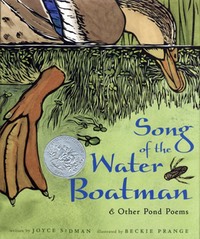
Joyce Sidman Poetry: Song of the Water Boatman & Other Pond Poems

Sidman, Joyce. 2005. Song of the Water Boatman & Other Pond Poems. Illustrated by Beckie Prange. Boston: Houghton Mifflin. ISBN: 9780618135479.

Song of the Water Boatman & Other Pond Poems Title Image
Image courtesy Joyce Sidman
Review and Critical Analysis

Joyce Sidman’s Song of the Water Boatman & Other Pond Poems is a collection of 11 poems that explore the ecosystem of a pond from the beginning of spring through the onset of winter. The poems are a combination of forms including rhyming poems, free verse poems, and shape poems. Each poem is accompanied by a beautiful ¾ to full page woodblock illustration hand-colored with watercolor and a short paragraph that provides information about the organism depicted in the poem.

The language Sidman uses make the poems accessible for young children. The poems themselves use imagery and concrete language to explain the habitat and behavior of unfamiliar animals and plants in a way that is understandable for children. For example, in “Listen for Me” the arrival of the spring peepers is described from the point of view of one of the frogs saying, “I creep up from the cold pond/the ice pond,/the winter pond.” Any academic or technical vocabulary such as “herbivorous” and “carnivorous” is reserved for the sidebars where the terms are first explained and included in parentheses. Young readers can enjoy the poems and learn important vocabulary words without difficult language getting in the way of the poems.

Sidman uses several different repetition and rhythm to create patterns throughout the poems in Song of the Water Boatman & Other Pond Poems. For example, in “Listen for Me” Sidman repeats the last word at the end of the first four lines of each stanza. The repetition is extended to a refrain in “Song of the Water Boatman and Backswimmer’s Refrain” where each stanza ends with a variation of the refrain “Yo, ho, ho,/the pond winds blow.” The various forms of repetition provide ample opportunities for choral reading and performance.

Song of the Water Boatman & Other Pond Poems is a 2006 Caldecott Honor Book and an excellent resource to use in support of a wide variety of science concepts.

Example Poem
In the Depths of the Summer Pond

Here hang the algae, green and small,
in the depths of the summer pond.

Here floats the flea, waving antennae,
that eats the algae, green and small,
in the depths of the summer pond.

Here nods the nymph with feathery gills
that drinks the flea,
that eats the algae, green and small,
in the depths of the summer pond.

Here dives the bug, sleek and swift,
that nabs the nymph
that drinks the flea
that eats the algae, green and small,
in the depths of the summer pond.

Here kicks the frog with golden eyes
that gulps the bug,
that nabs the nymph
that drinks the flea
that eats the algae, green and small,
in the depths of the summer pond.

Here lurks the fish, wide of jaw,
that swallows the frog
that gulps the bug,
that nabs the nymph
that drinks the flea
that eats the algae, green and small,
in the depths of the summer pond.

Here hunts the heron, queen of the pond,
that spears the fish,
that swallows the frog
that gulps the bug,
that nabs the nymph
that drinks the flea
that eats the algae, green and small,
in the depths of the summer pond.

Activity

“In the Depths of the Summer Pond” is a great poem to use with students who are studying the food chain in their science classes. Begin by asking students what they know about food chains and food webs. Have them explain key vocabulary like consumers, producers, and decomposers. Then explain that you will be reading a poems that explores a food chain in a specific ecosystem--a pond during the summertime.

Read through the poem once or twice for students to model pronunciation of words and the rhythm. Children of all ages will pick up the repetition of the the lines “that eats the algae, green and small,/in the depths of the summer pond” and will likely join in after the first few stanzas. Once students have a feel for the rhythm, divide the students into seven groups (or select seven readers). Assign each group one of the animals, and allow them time to practice their parts. Then have the groups read the lines about their animal in each stanza, with everyone chiming in for the line “in the depths of the summer pond.” 

As an extension, give the students another ecosystem--the ocean, the rainforest, the woods, or the desert--and ask them to identify seven parts of a food chain for that ecosystem. Working with their group members, students could then produce an illustration or find a public domain or Creative Commons digital image online and write a line of poetry to describe their animal. All the images and lines can be put together on the wall or in photo editing software to make a food chain diagram.

Monday, February 13, 2017

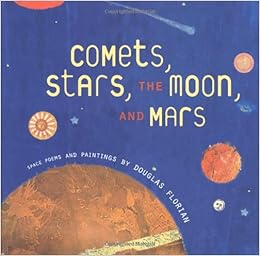
Florian Poetry: Comets, Stars, the Moon, and Mars

Florian, Douglas. 2007. Comets, Stars, the Moon, and Mars. Orlando: Harcourt. ISBN: 9780152053727.

Image courtesy Amazon.com
Review and Critical Analysis
Douglas Florian's Comets, Stars, the Moon, and Mars is a beautiful informational book of 20 poems about all things space-related.  The text has many of the expected features of an informational book, such as a table of contents, a glossary of terms, and suggestions for further reading, but this book is so much more than just an informational book.

This book is first and foremost a poetry book. Florian's poems all have a strong rhyme and rhythm to them. For example, the first poem, "Skywatch" begins "On a clear night you might try/To gaze upon the starry sky." While both the rhyme and rhythm are strong throughout the book, Florian varies the rhyme scheme and rhythm to keep the poems from becoming to sing-song and predictable. Additionally, the poems include strong imagery and figurative language, like a description of the sun's "Scalding-hot surface" or the comparison of a comet to "A dirty snowball of space debris."

The artwork that accompanies each poem--also by Florian--adds another layer of richness to the writing. The illustrations of goache, collage, and rubber stamps on primed brown paper bags create vibrant scenes for readers to explore. Not only does the artwork depict the space element serving as the subject of the poem, the rubber stamp lettering labels other features like moons, geographical features and other key components. My favorite spread is for the poem titled "A Galaxy." The background is a deep navy blue, nearly black, that looks like the abyss of outer space. The poem itself takes the shape of a spiral galaxy, and other galaxy shapes, like barred, elliptical, and egg-shaped galaxies, are depicted in beige with bright orange outlines. The visual effect is stunning, and the additional shapes provide the opportunity for readers to explore the concept further. The illustrations--combined with loads of space facts and fun poems-- make this a book of poetry that readers will want to sit down with and explore. Older children may even want to look up some of the names incorporated into the design to figure out why the names are included.

Young readers will love the strong rhyme and rhythm of Florian's poems in Comets, Stars, the Moon, and Mars. These traits make it a perfect book for reading aloud or call and response readings. Plus, the witty, whimsical nature of some of the poems will draw children in as well. For example, in "Pluto," the poet explains the dwarf planet's demotion, saying "Pluto was a planet./Till one day it got fired."  Florian's comparison of a black hole to a "Cosmic broom" and then wishing he had one for his room will delight younger readers as well. This book is an excellent support for the science classroom.

Example Poem
Venus

Scalding-hot surface
Nine hundred degrees,
No creatures,
No trees.
Poisonous clouds
Of acid above.
Why was it named for
the goddess of love?

Activity
Every poem in this book could be used in an astronomy unit in the science classroom. I can see the poems serving both as introductions to plants, constellations, and black holes or as reviews to see what students remember about previous lessons. The possibilities are endless!

One way I would consider using the planet poems like "Venus" is to use them as part of a check for understanding before assessing knowledge of a particular planet. I would introduce the poem by asking children, "What do you know about the planet Venus?" After giving the group a chance to share everything they can remember, I would read the poem to them at least two times--one time to give them the opportunity to simply enjoy the poem and another to have them listen for facts. After discussing what the poet chose to include and leave out, students could then use both Florian's illustration and other pictures (both realistic and artistic) of the planet as inspiration to create their own illustration of the planet Venus. The illustrations could then be incorporated to a trading card design for display.