Showing posts with label sound devices. Show all posts

Wednesday, May 3, 2017

Janeczko Collection: Hey You!


Janeczko, Paul B., comp. 2007. Hey You!: Poems to Skyscrapers, Mosquitoes, and Other Fun Things. Illustrated by Robert Rayevsky. New York: HarperCollins. ISBN: 9780060523480.

Image courtesy
Paul B. Janeczko
Review and Critical Analysis
In Hey You!: Poems to Skyscrapers, Mosquitoes, and Other Fun Things, Paul B. Janeczko has collected 30 poems by 25 different poets--from classic poets like Emily Dickinson to more modern poets like Douglas Florian and Nikki Grimes. The contents of the poems vary from black holes, to skyscrapers, to bees, and everything in between. Like the topics, the forms are varied, too. The book contains free verse poems, letter poems, and rhyming poems. The one unifying factor that unifies these poems is the fact that they are apostrophe poems, each one written to a specific object.

While the level of the language differs from poem to poem, the nature of apostrophe poems elicits elements of personification in almost every poem. For example, in “Sneakers” by Joan Bransfield Graham, the speaker comments on her shoes that appear “ready to blaze into/the day, either with or without/my feet!” and in X.J. Kennedy’s “To a Snowflake,” the speaker attributes the power of thought to snowflakes as the speaker considers how the snowflake cannot “Make up your wisher where/You wish to spend tonight.” The poets in Hey You! bring all of these ordinary objects to life through personification. Many of the poems build on this personification with imagery and figurative language. Naomi Shihab Nye’s “Little Blanco River” is one of the most vivid examples. Nye’s speaker describes the river, whose “...smooth shale skull/is slick & cool.” She depicts the river as making “...a clean swishing sound/centuries of skirts/lifting & falling in delicate rounds.” Though the language varies among these poems, each one reflects a close, intimate examination of an object that has made itself important to the speaker.

In Janeczko’s selections for Hey You!, the poems use sound in several different ways. Marjorie Maddox’s “Warning to a Fork” includes line after line of alliteration to build a strong rhythm and sense of foreboding. The poem warns the “Pitchfork for pie,/trident for tuna salad” to beware the “mangler of metal utensils,/mortuary of soup spoons and knives.” This alliteration works in conjunction with the onomatopoeic description of the “clank and crunch” of the garbage disposal to create such a dire warning. Unlike the dark nature of “Warning to a Fork,” Russell Hoban’s “Soft-Boiled” uses strong rhythm and end rhyme to create a light-hearted tone reminiscent of Dr. Seuss. His opening lines, “I do not like the way you slide,/I do not like your soft inside,” will conjure Green Eggs and Ham for almost any one.

The poems are accompanied by the cartoon-style illustrations of Robert Rayevsky in the foreground of each spread. The backgrounds of the visuals vary from what appears to be blurred photographs to watercolor paintings to abstract designs. Even the illustrations for the poems take on a variety of tones and textures. Despite their wide range, the images are connected by some type of blur or hazy effect added to each one that gives the pages a dream-like feeling.

Hey You! is a varied collection of poems from well-known poets of quality. While the poems have no clear theme, they provide excellent examples of the many ways poets can use apostrophe.

Example Poem
Sneakers
By Joan Bransfield Graham

Sneakers,
glancing from bed,
I see morning light cast
long shadows behind you just like
comets.

Your tails
flaring, you seem
ready to blaze into
the day, either with or without my feet!

Activity
Have students look at several different types of shoes. You can invite students to sit in a circle and display their shoes to each other, or, if you feel using student shoes might cause a student embarrassment, you could use images of shoes or a selection of your own shoes. Ask students questions that lead them to think of the shoes personified. For example, you could ask students to explain which shoes they think have the most energy? Which ones are tired? Which shoes look like they have been on many adventures? Do any of the shoes seem angry? Excited? Shy? After students have had a chance to respond to the shoes, explain that you are going to read a poem from the point of view of a child speaking to their sneakers.

After reading “Sneakers” at least once or twice, invite students to share what they noticed about the poem. Students should notice that the speaker is talking to shoes that do not have the ability to respond. Ask them to imagine what would happen if the shoes came to life. What might the shoes say in response to the child?

As an extension, students may choose to write a 1-2 stanza poem from the point of view of the shoes that gives its response to the child. Other students may wish to write their own poem that speaks to a specific object like their desk, the school bus, or their favorite game.

Friday, April 14, 2017

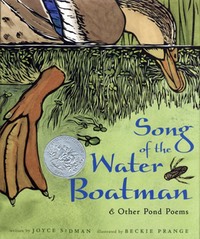
Joyce Sidman Poetry: Song of the Water Boatman & Other Pond Poems

Sidman, Joyce. 2005. Song of the Water Boatman & Other Pond Poems. Illustrated by Beckie Prange. Boston: Houghton Mifflin. ISBN: 9780618135479.

Song of the Water Boatman & Other Pond Poems Title Image
Image courtesy Joyce Sidman
Review and Critical Analysis

Joyce Sidman’s Song of the Water Boatman & Other Pond Poems is a collection of 11 poems that explore the ecosystem of a pond from the beginning of spring through the onset of winter. The poems are a combination of forms including rhyming poems, free verse poems, and shape poems. Each poem is accompanied by a beautiful ¾ to full page woodblock illustration hand-colored with watercolor and a short paragraph that provides information about the organism depicted in the poem.

The language Sidman uses make the poems accessible for young children. The poems themselves use imagery and concrete language to explain the habitat and behavior of unfamiliar animals and plants in a way that is understandable for children. For example, in “Listen for Me” the arrival of the spring peepers is described from the point of view of one of the frogs saying, “I creep up from the cold pond/the ice pond,/the winter pond.” Any academic or technical vocabulary such as “herbivorous” and “carnivorous” is reserved for the sidebars where the terms are first explained and included in parentheses. Young readers can enjoy the poems and learn important vocabulary words without difficult language getting in the way of the poems.

Sidman uses several different repetition and rhythm to create patterns throughout the poems in Song of the Water Boatman & Other Pond Poems. For example, in “Listen for Me” Sidman repeats the last word at the end of the first four lines of each stanza. The repetition is extended to a refrain in “Song of the Water Boatman and Backswimmer’s Refrain” where each stanza ends with a variation of the refrain “Yo, ho, ho,/the pond winds blow.” The various forms of repetition provide ample opportunities for choral reading and performance.

Song of the Water Boatman & Other Pond Poems is a 2006 Caldecott Honor Book and an excellent resource to use in support of a wide variety of science concepts.

Example Poem
In the Depths of the Summer Pond

Here hang the algae, green and small,
in the depths of the summer pond.

Here floats the flea, waving antennae,
that eats the algae, green and small,
in the depths of the summer pond.

Here nods the nymph with feathery gills
that drinks the flea,
that eats the algae, green and small,
in the depths of the summer pond.

Here dives the bug, sleek and swift,
that nabs the nymph
that drinks the flea
that eats the algae, green and small,
in the depths of the summer pond.

Here kicks the frog with golden eyes
that gulps the bug,
that nabs the nymph
that drinks the flea
that eats the algae, green and small,
in the depths of the summer pond.

Here lurks the fish, wide of jaw,
that swallows the frog
that gulps the bug,
that nabs the nymph
that drinks the flea
that eats the algae, green and small,
in the depths of the summer pond.

Here hunts the heron, queen of the pond,
that spears the fish,
that swallows the frog
that gulps the bug,
that nabs the nymph
that drinks the flea
that eats the algae, green and small,
in the depths of the summer pond.

Activity

“In the Depths of the Summer Pond” is a great poem to use with students who are studying the food chain in their science classes. Begin by asking students what they know about food chains and food webs. Have them explain key vocabulary like consumers, producers, and decomposers. Then explain that you will be reading a poems that explores a food chain in a specific ecosystem--a pond during the summertime.

Read through the poem once or twice for students to model pronunciation of words and the rhythm. Children of all ages will pick up the repetition of the the lines “that eats the algae, green and small,/in the depths of the summer pond” and will likely join in after the first few stanzas. Once students have a feel for the rhythm, divide the students into seven groups (or select seven readers). Assign each group one of the animals, and allow them time to practice their parts. Then have the groups read the lines about their animal in each stanza, with everyone chiming in for the line “in the depths of the summer pond.” 

As an extension, give the students another ecosystem--the ocean, the rainforest, the woods, or the desert--and ask them to identify seven parts of a food chain for that ecosystem. Working with their group members, students could then produce an illustration or find a public domain or Creative Commons digital image online and write a line of poetry to describe their animal. All the images and lines can be put together on the wall or in photo editing software to make a food chain diagram.

Tuesday, April 11, 2017

Performance Poetry: The Friendly Four

Greenfield, Eloise. 2006. The Friendly Four. Illustrated by Jon Spivey Gilchrist. New York: Harper Collins. ISBN: 9780060007607.


Image courtesy Harper Collins Publishers
Review and Critical Analysis
Eloise Greenfield’s The Friendly Four is a collection of 34 poems for children that work together to tell the one story of the summertime adventures of four children--Drummond, Dorene, Louis, and Rae. These children each face common struggles like being overshadowed by a baby sibling, moving to a new place, being adopted, or coping with a seriously ill parent. Over the course of one summer, these young friends learn to depend on each other and inspire one another through play and imagination.

The language of The Friendly Four is fairly straightforward to make it easily understandable for children in preschool to third grade. The text does include some simple similes and metaphors like “... churning/our legs like bicycle wheels” in the poem “The Race” and “Every day away from her/would be a thousand years” in “Going to Get Rae.” Teachers and librarians can find examples to illustrate almost any poetic device, but as a collection, the poems read more like everyday childhood conversation, making the book approachable for early readers.

The same could also be said for Greenfield’s use of sound devices in The Friendly Four. Sound devices like repetition, rhyme, and alliteration help establish a distinct rhythm at times, the patterns of everyday speech are the driving factor. Repetition and alliteration such as “likes to wrestle/likes to run/likes to count” are sprinkled in just enough to break up the conversational pattern to remind readers that they are indeed reading poetry.

The most distinctive trait of Greenfield’s poetry is the features included to structure these poems for performance. The lines spoken by each of the four children is marked by four different colors, and only lines to be read in multiple voices together are printed in black. Speakers are indicated like they would be in a script, so this book is ready to pick up and start practicing for performance without any additional markup to the text.

Example Poem
Here Comes the Truck

All:


Here comes the truck,
carrying sheets of cardboard,
cans of paint, and brushes,
Drum and Rae:


carrying sticky tape,
and colored paper,
and markers,
Dorene and Louis:and glitter
and glue.
All:Now we have everything
we need, to make a town
that has beauty and laughter
and heart.
Louis:Let's get started!

Activity

To introduce this poem, I would ask if they ever thought up something and tried to make it from their own imagination. For example, about the closest I ever came up with was a blanket fort or a sock puppet. After students had an opportunity to share what they have made, I would show them the video “Caine’s Arcade” (available on YouTube).

I would read the poem once and then ask for volunteers to read the poem at least two more times to practice reading their lines together in unison. Ask students what they would build if they had all the supplies that Drum, Dorene, Louis, and Rae had. Would they make a town like the children did? An arcade like Caine? Or something totally different?

As an extension, students could work as individuals or small groups to participate in the Global Cardboard Challenge sponsored by the Imagination Foundation, which was started by a group of people who were inspired by Caine and his arcade.

Resources
Imagination Foundation. 2017. “2017 Global Cardboard Challenge.” Accessed April 11. http://carboardchallenge.com.

Mullick, Nirvan. “Caine’s Arcade.” Filmed [October 2012]. YouTube video, 10:58. Posted [April 2012]. https://youtu.be/faIFNkdq96U.

Monday, April 10, 2017

Hopkins Award Poetry: Jazz

Myers, Walter Dean. 2006. Jazz. Illustrated by Christopher Myers. New York: Holiday House. ISBN: 9780823415458.


Image courtesy walterdeanmyers.net
Review and Critical Analysis
Jazz by Walter Dean Myers is a collection of fifteen poems that recreate the experience of jazz music. From the opening poem that
summons the drumming rhythms of jazz’s African heritage to the poem “Three Voices” that highlights jazz instruments like the bass, piano, and horn, each poem presents an experience with the rhythms and emotions of jazz music.

The language of Jazz gives readers a sense of the motivating power of jazz music. The verbs Myers uses all portray active, vibrant movement. For example, in “Good-bye to Old Bob Johnson,” Myers employs verbs like “swinging,” “singing,” “stepping,” and “dipping” to describe the actions of the mourners. Even in a serious occasion like a funeral procession, the people are so filled with emotion they can’t help but move to the music.

Myers further connects the subject of jazz music with his poetry through his use of sound devices in each of the poems. He uses different forms of rhyme and repetition to create a jazz rhythm in each poem. In “Stride,” he accomplishes this by combining both internal and end rhyme with repeated words as he starts the poem:

We got jiving in our bones, and it won’t leave use alone--we’re really moving
               Jiving      bones
We got pride in our stride, and we know it’s all the style--we’re steady grooving
               Pride      stride.

The visuals in Jazz provide another layer to the power and emotion conveyed by the language. Myers’s son, Christopher created bold images of musicians and instruments with bright colored backgrounds by layering black ink on acetate over acrylic paintings to create striking illustrations with depth and richness. Even the typography of the poems includes multiple fonts and colors emphasizes key lines of the poems and adds movement to the words.

Jazz begins with an introduction to jazz music and its history and closes with a glossary of jazz and a jazz timeline, providing nonfiction text features to support the historical significance of jazz music and the jazz artists noted in the poems. The Lee Bennett Hopkins Poetry Award Honor book and ALA Notable Children’s Book is a beautiful library or classroom resource to connect music, painting, poetry, and history.

Example Poem

It’s Jazz

I hear the call of the cornet
I hear a swinging clarinet
They’re playing HOT jazz in the heat
Of old New Orleans
The rattling banjo pays its dues
To the Preservation blues
They’re playing HOT jazz in the heat
Of old New Orleans
There’s a crazy syncopation
And it’s tearing through the nation
And it’s bringing sweet elation
To every single tune
It’s jazz
There’s a drummer rat-a-tatting
There’s a patent shoe that’s patting
While a laid-back cat is scatting
About flying to the moon
It’s jazz
In the HEAT of New Orleans


Activity
To introduce this poem to students, begin by playing a little jazz music for students to get a feel for the musical style. You might play one of the jazz musicians named in the poems, like Louis Armstrong, Robert Johnson, or you might select an artist from the jazz timeline at the end, such as Billie Holiday, Duke Ellington, or Benny Goodman.

As an extension after reading the poem, allow students to make their own percussion instruments like tin can drums, sand blocks, water bottle rattles, or even a homemade didgeridoo. Then, either as a whole class, in small groups, or even as individuals, students can practice the rhythm of the poem with their instruments and perform their own interpretation of this poem or other poems from Jazz.

Thursday, February 16, 2017

Multicultural Poetry: Yum! MmMm! Que Rico!: America's Sproutings

Mora, Pat. 2007. Yum! MmMm! Qué Rico!: America's Sproutings. Pictures by Rafael López. New York: Lee & Low. ISBN 9781584302711.


Image courtesy Amazon.com
Review and Critical Summary
Pat Mora's Yum! MmMm! Qué Rico! includes fourteen haiku celebrating delicious foods native to the Americas. From corn and tomatoes to chocolate and pineapple, Mora includes a variety of treats for young readers. With each tasty poem, Mora includes a short factual description of the food, its history, and even its modern use.

The seventeen syllable poems abound with sound devices.  Mora employs alliteration with corn leaves that "sprout silk-snug house" and a tomato that "squirts seedy-juicy splatter" as well as the assonance of a cranberry that "simmers then POPS! in hot pot." In "Pecan," Mora creates the sound of a person cracking and eating pecans with instances of onomatopoeia like "crack," "munching," and "crunchy." The use of sound imagery gives readers a food experience that makes use of more than just the expected sight and taste imagery.

Yum! MmMm! Qué Rico! creates a multi-sensory experience with one of my favorite types of figurative language -- synesthesia--or the use of sensory language that evokes the sensation of a different sense. For example, the first poem, "Blueberry" opens with the line "Fill your mouth with blue," suggesting the when eating a blueberry, one can use his or her tongue to taste and feel the color blue. This same device pops up again in the poem "Chile," when the narrator's dad says, "Mmmm! This heat tastes good."

This book of poems will have special appeal for Spanish speaking students. In addition to the Spanish phrase qué rico in the title, Mora also includes other Spanish words like luna in "Pumpkin" or dulces  in "Prickly Pear," providing opportunities for Spanish speakers to be the experts in pronouncing those words or translating them for the other students.

Mora's engaging language is made even more beautiful with the captivating artwork by Rafael López. Whether its a chocolate castle floating on a cloud or a giant personified pineapple dancing with maracas, each full page spread is fancifully illustrated in bright colors that embrace the sense of the food. The people depicted in the illustrations represent the diverse population of the Americas, as well. The characters have a variety of skin tones, hair colors, and even hair types. While most of the characters are children (as one might expect in a children's book), some of the illustrations include multi-generational families with parents and grandparents. The artwork, like the food described in the poems, reflect the diversity of the Americas.

Example Poem
Peanut

Smear nutty butter,
then jelly. Gooey party
my sandwich and me.

Activity
To introduce this poem to students,  ask for volunteers to share their favorite food. After students offer their favorite foods to the group, explain that you are going to share a poem about your favorite food. You might even give the students some information from the facts about peanuts before reading the poem. After you have read the poem aloud, ask the students to guess what your favorite food is.

As an extension, students could use art supplies to draw or glue pictures of their favorite foods onto paper plates. They may also want to try their hand at writing a haiku about their favorite food on their plate.

Monday, January 30, 2017

Hopkins Collection: City I Love

Hopkins, Lee Bennett. 2009. City I Love. Illustrated by Marcellus Hall. New York: Adams. ISBN 9780810983274

Cover image of City I Love
Image courtesy of SLJ Blog

Review and Critical Analysis

Lee Bennett Hopkins’s City I Love celebrates the sights and sounds of urban life through 18 poems about the subways and taxis and skyscrapers and the noises that fill the city. While the content of the poems could apply to any city, the accompanying illustrations of iconic landmarks like the Washington monument, Big Ben, and the Great Pyramids clearly set each poem in a particular city. Additionally, the endpapers display a world map pinpointing the 18 major cities featured in the illustrations. Young readers will enjoy spotting the cartoon dog, who has donned a backpack to set out on his world travels with his partner, a little blue bird. The traveling companions appear somewhere in each illustration throughout the book.

The poems in City I Love take a variety of shapes and forms, including haiku, free verse, and rhyming couplets. Though the poems contain plenty of concrete visual imagery like descriptions of the sun as “fiery/orange-red” in “City Summer,” the sound devices Hopkins employs are the star of the book. The very first poem “Sing a Song of Cities” sets the tone for the entire book as it begins, “Sing a song of cities/If you do,/Cities will sing back/to you,” establishing a sense of awe-inspiring grandeur from the city. From there, onomatopoeia, alliteration, rhyme, and rhythm take over to create the hustle and bustle of the city for readers. The subway “roars and rumbles,” water is “pouring/roaring/gushing/rushing” from hydrants, and people shout “Taxi!” and “Hot dogs with sauerkraut/Get ‘em here!” Each poem adds another layer of city sounds to the description.

The illustrations by New Yorker artist Marcellus Hall take the poems to another level. The large, colorful brush, ink, and watercolor city scenes dominate most of the spreads. The one to two poems on each spread mostly sit along sidebars or in the negative space of the sky, but occasionally, the poems and illustrations are so intertwined determining which came first is a challenge. For example, a full-spread line of cars and double-decker buses drive right through the middle of the poem titled “Taxi!” and words of “Subways Are People” follow the same v-shape as the lines of perspective in the drawing of the people on a subway, ending near the picture’s vanishing point. The beautiful artwork alone makes this book worth a second read. I find something new every time I pick it up.

City I Love will provide readers with plenty of entertainment and enjoyment. The poems about city life will ring true with children from cities, yet the content--with bridges, kites, and summer--is so universal that children from rural areas can still connect with the poems for a new learning experience about cities. The illustrations are engaging, providing the perfect opportunity for exploration with friends, siblings, or parents. Plus, the wide range of cultures reflected in the specific cities highlighted simply beg for further exploration to learn about the cities or find pictures of the real landmarks online.

Example Poem

"City I Love"

In the city
I live in--
city I love--
mornings wake
to swishes, swashes,
sputters
of sweepers
swooshing litter
from gutters.

In the city
I live in--
city I love--
afternoons pulse
with
people hurrying,
scurrying--
races of faces
pacing to
must-get-there
places.

In the city
I live in--
city I love--
nights shimmer
with lights
competing
with stars above
unknown heights.

In the city
I live in--
city I love--
as dreams start to creep
my city
of senses
lulls
me 
to
sleep.

Activity

Before reading this poem with children, I would introduce the poem by asking if they live in the city or in the country, and I invite them to share what sounds they might hear on a daily basis where they live. For younger children, we could make one collaborative list of sounds, or older students might want to make their own lists of sounds and then share a few ideas.

After reading the poem I would ask students if they heard any of their sounds in the poem, or if anything in the poem reminds them of where they live. As a follow up, students could write a poem, using the first three lines “In the city/I live in--/city I love--” to begin their own stanzas. As necessary, they could change “city” to a more appropriate term like “town,” “country,” or--for the East Texans-- “woods.”